6 Benefits of Multi-Axis CNC Machining

Computer numerical control (CNC) machines have come a long way in less than a century of existence. The original CNC machine built in the 50s revolutionized the production of components by subtractive manufacturing across three axes, opening up the possibility for the machining of complex shapes and designs that were previously difficult or impossible to manufacture. The machines available today, with anywhere between 5 and 9 axes can produce products with unbelievably complex geometries, quickly and efficiently. To understand why, we first have to understand a bit about what it means for a machine to have multiple axes. 

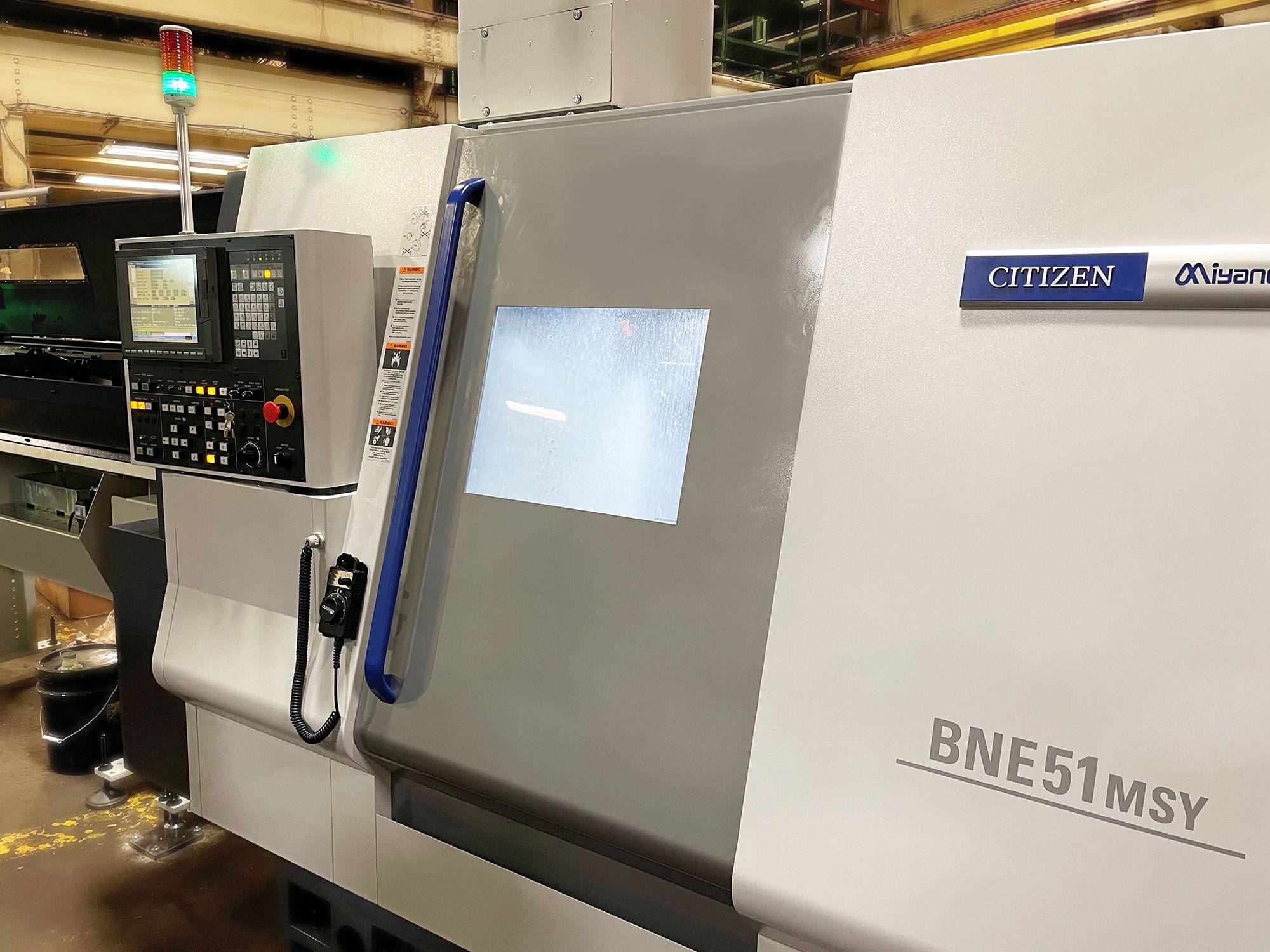
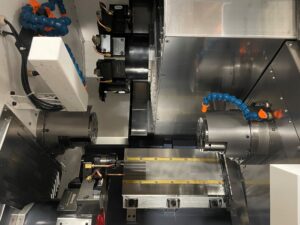
Take a look at the 9-Axis Swiss Lathe Center we use for part production in our shop, pictured above

What is a Multi-Axis Machine?

Though technically a 3-axis cnc machine is operating on multiple axes, we typically only refer to machines of 5 axes or more as “multi-axis” as it’s at this level or higher that more complex geometries with deeper cuts can be produced. But why exactly is a higher number of axes important in machining? With fewer axes that the cutting and milling tools can ride on to approach a turning piece of bar stock, the angles that the tools can reach relative to the piece are limited. SImply put, the more axes available, the more opportunity to get closer to the stock and perform cutting operations at various angles, allowing for more complex machining without the need to move or rotate the stock material. Combined with the addition of a separate spindle and a variety of tooling, and you have a machine capable of completing complex cuts quickly, efficiently and with higher accuracy.

For this reason, investing in multi-axis CNC machining produces greater productivity and improves numerous manufacturing metrics, delivering a measurable and significant ROI through several advantages over machining on a traditional 3-axis cnc machine.

6 Benefits of Multi-Axis Machining 

1.Higher Precision and Accuracy

Multi axis CNC machines operate with greater precision to deliver accurately machined and smoother parts that would be difficult or even impossible to achieve with a 3-axis machine. With a traditional 3-axis cnc machine, the tooling can only approach the workpiece at a few points, limiting the angles from which the stock can be cut away. 

Therefore, to create more complex parts with a 3-axis machine, the workpiece would have to be moved and repositioned for various cuts. Each time a workpiece is moved within the machining process, accuracy and precision are compromised. The multi-axis machines we have access to today can reach workpieces at various angles, and operate more closely to the workpiece, allowing for a complex array of geometries to be performed within a single setup, with no repositioning required. 

2. Improved Production Speed (Lead Times)

The tangential arrangement of the cutting tools to the material with multi-axis machining allows for more material to be removed with each rotation, increasing the speed that single applications can be performed. When this is combined with expanded tooling capabilities and multi-axis simultaneous machining from a single setup, cycle times improve significantly. This can lead to drastically reduced lead times.

3. Fewer Setups 

With multi axis machines, you can set up your workpieces at one time to handle all milling/turning operations needed to fabricate complex geometries. You’ll produce parts faster, minimize operational costs, and reduce most errors prevalent in conventional 3-axis machines.

4. More Complex Part Geometries

The ability of multi-axis CNC machining to move workpieces over more dimensions without removing them gives it a significant advantage over conventional 3-axis machining. Cnc machines with 5 axes or more can get tools very close to the working material at various angles, creating the ability for deep cuts and complex shapes that were not achievable from only 3-axes machines. The greater the axes, the better the machine can handle complex designs with high precision. 

Any time a workpiece needs to be repositioned for a separate set of cutting operations, a degree of precision is lost. High level multi-axis cnc machines, like our 9-axis Miyano,  deliver the most complex parts with extreme precision. These machines attack the most complicated angles to create complex geometries with premium finishes at tighter tolerances.

5. Better Surface Finishes

Multi axis machines bring the cutting tools closer to the working material. Shorter cutting tools produce better surface finishes because the shortened length makes them less susceptible to machining vibration. This produces a cleaner product directly from the machining process and minimizes the need for additional touch ups.

6. Improved Drilling Capabilities

Multi-axis cnc machines change the game for drilling applications. Each time a part is moved in a CNC operation, there’s an opportunity for error or loss of precision. Since parts hold their position through various applications in multi-axis machining, precision is maintained even through separate drilling applications with different variants. The additional axes also allow the machine to reach tighter and more complex angles, completing  more complex drilling applications with finer finishes.


Industries that Rely on Multi-Axis Machining 

Multi-axis machining is the name of the game for any production that requires a high level of accuracy and precision of its parts, without fail. This could apply to nearly any industry in manufacturing; however, there are a few that rely on multi-axis machining more regularly than others, such as the following: 

  • Aerospace – Typical aerospace components produced by multi axis CNC tools include valves and turbine blades requiring precise execution on complex geometries.
  • Automotive – The high throughput of multi axis equipment make these machines ideal for the low-mix, high-volume production needed for the automotive industry while maintaining the highest quality.
  • Medical – Medical instruments, drills, implants, devices, and equipment parts must meet strict quality standards. The ability of multi axis machines to produce the necessary quality at greater speed and the highest accuracy gives medical component manufacturers greater confidence.
  • Energy – The oil and gas production industry parts produced from extremely hard steels and exotic alloys using multi axis machines. The complex components that energy equipment needs. Such parts include wind turbines and compressor blades.

The introduction of multi-axis machining in cnc revolutionized manufacturing by opening the floodgates for the production of complex parts with previously unattainable levels of accuracy, quality and control. This is why it’s important to select a cnc machining company that has machines of 5 axes or more in use. At M&M Automatic, we are always looking for the best ways to offer our customers the quality they expect with the lowest lead times and operate cnc turning machines with up to 9 axes for maximum speed and precision. Feel free to contact us to hear about how we can assist your production needs, or request a quote for your next job today. 
CNC Turned Products vs. Screw Machine Products

CNC Turning Verses Screw Machine

When the screw machine product was created 100 years ago, it’s original purpose was to make screws for a variety of different products. However, while the name has remained the same, the technology behind a screw machine product has evolved throughout the years to meet the needs of modern turned components. CNC (or computer numerical control) turned products is the automation of machine tools that operate via computer-programmed commands, as opposed to mechanically automated machines such as a screw machine. So, what are the benefits of each?


Screw Machine Products

A screw machine product is a class of automatic lathes for small to medium sized parts. The name “screw machine” is considered to be a tad misleading, as these machines don’t only create screws anymore or screw anything into place. Instead, these machines work by spinning metal bar stock on a rotating lathe, which essentially shaves the metal down to a desired size and shape. A screw machine functions with a disc cam, which is a rotating piece used to transform rotary motion into linear motion, or vice versa, using either a single spindle or multiple. Because a screw machine operates with closed spindle collets which hold the cutting tool, deflected debris is reduced to minimal or none at all.

Screw Machine Manufacturing Capabilities

Screw machines are used for bar work in a variety of shapes such as round, hex, or square. The entire bar stock is passed through and turns with the spindle, and is then separated from the part and fed forward, making the screw machine ready for the next part. Screw machines are more time efficient than CNC with their ability to turn 6 to 8 operations simultaneously depending on the number of spindles the machine has. Typically, most automatic screw machines have 6 spindles with some having up to 8 spindles. Screw machines can hold and repeat with tolerances of .0025” of an inch.

CNC Turned Products

The first CNC machines were created in the 1940s and 1950s, modifying existing tools and implementing motors into the design. CNC products essentially function the same way as screw machine products, but instead of being operated by cams, they are mainly controlled by computers. Having transformed a great deal throughout the years, CNC turned products are now equipped to feature more sets of tooling than screw machine products, which allow the machines to perform multiple operations on a part in a shorter amount of time.

CNC Turning Manufacturing Capabilities

CNC turned parts are known for being more precise than its predecessor the automatic screw machine. A CNC machine can rotate parts to speeds up to and exceed 10,000 RPM’s, with accuracies as tight as .0002” of an inch. With accuracies that are able to be achieved and its repeatability it has become the most dependable and efficient way to manufacture precision parts worldwide. Because of the machine’s extreme precision, it is used in a variety of industries such as automotive, aerospace, medical, agricultural, and more.

Do you need a part created but aren’t sure what would be the best process – CNC turning or screw machines? Ask us! We’ll be happy to help you figure it out.

Another Powerful Addition: Miyano BNE-51MSY

In addition to the newly added Haas DS-30Y, we brought in another turning center beast for 2023 – the Miyano BNE-51MSY. A brand known for high rigidity for top precision and heavy duty cutting capabilities, this new Citizens Miyano fixed headstock swiss lathe machine boasts 9 axes for cutting with 12+12 tooling capabilities between its two identical spindles. An added axis on the secondary spindle, a second turret and superimposed cutting capabilities enable synchronized drilling on front and back facing parts and 3-tool simultaneous cutting to chop cycle times and allow for the production of two complete precision parts in one operation.

We are very excited about the added production capabilities this brings to our shop and to our customers. See the breakdown of features below.

Miyano BNE-51MSY

What features does this new machine offer and what does it mean for your precision machined parts?

  • 9 Cutting Axes (X1, Z1, Y1, X2, Z2, X3, Z3, C1, C2) – The combination of 4-Axis Lathe and 5-Axis Milling capabilities allows for turning in every possibly direction, resulting in complex parts machined quickly and cleanly with one setup.
  • 2 Spindles with identical 6” chuck, 5,000 rpm and A2-6 noses allow for handling stock with the same capabilities in the front and back operations.
  • EDGE PATROIT 551 Bar Feeder for consistent feeding of round, square or hexagonal bar stock.
  • 2 Turrets with 24 (25-Nm) Revolving Tool Stations – A pair of identical turrets each equipped with 12 live tooling stations means detailed simultaneous milling on front and back face operations, in addition to the lathe function.
  • Y-Axis Slide
  • 2” Bar Capacity
  • Fixed Headstock

See the Miyano BNE-51MSY in Action:

This 9-Axis Swiss Lathe Center is a powerhouse of a machine that will further improve our already extensive capabilities, powering large quantity runs with the same short lead times and on-time, high precision production we have provided consistently for decades.

For more information on how we utilize our top of the line equipment to produce world-class quality machined parts, contact us – we’d love to hear from you.

Introducing Our Haas DS-30Y – High Volume Complex Part Machining, a True “Done in One” Machine

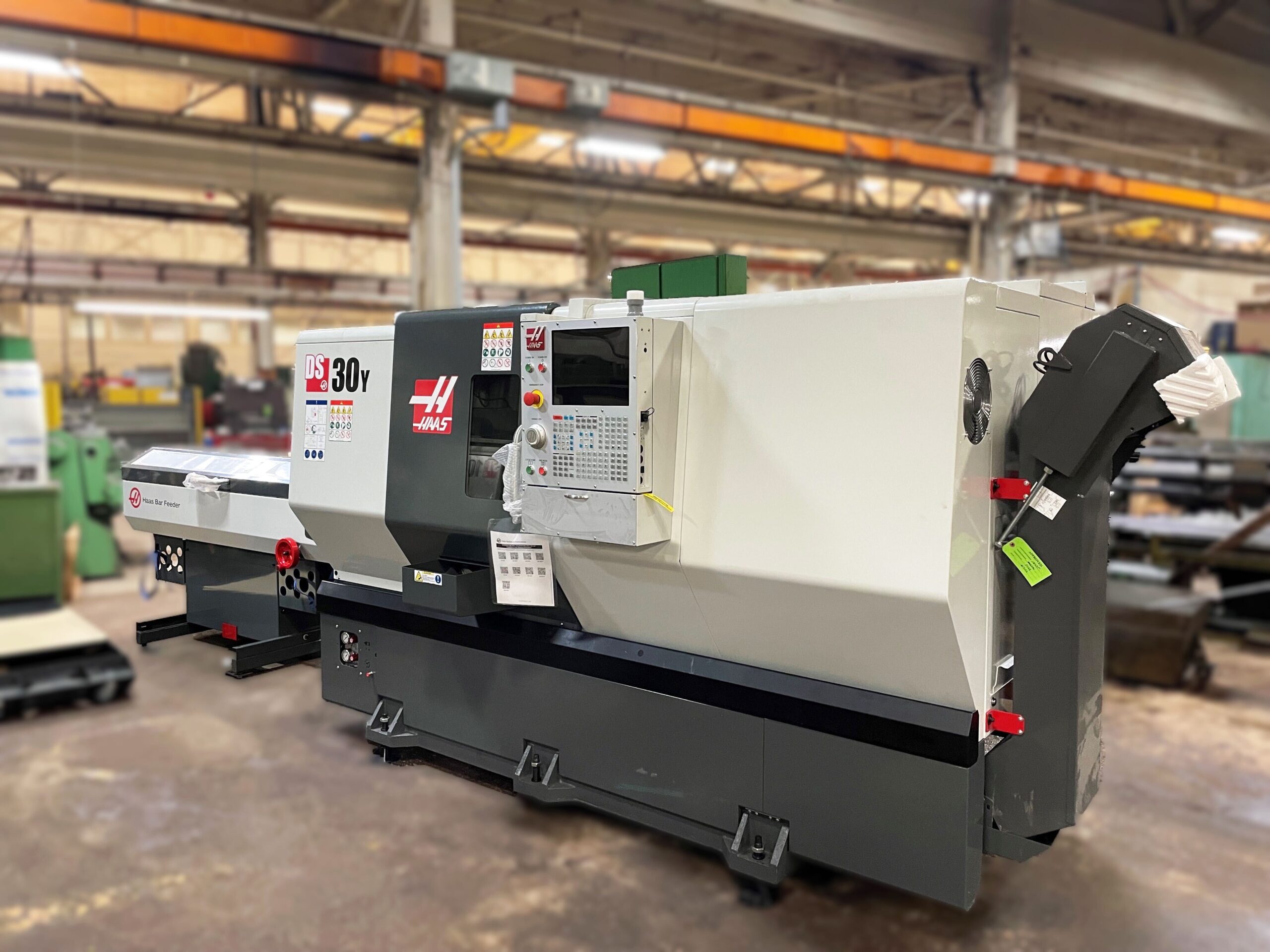
The new generation of Haas turning centers specialize in being extremely rigid, highly accurate and very thermally stable and our new Haas turning center, added to our equipment lineup at the end of last year, has proven to be a great addition to the floor. We are thrilled about the new capabilities this larger machine has brought to our shop and the expanded production options this offers our customers.

Haas-DS-30Y

The addition of the Haas DS-30Y improves our CNC Turning capabilities with dual spindles, computer automated part transfer and live tooling to handle complex designs on both faces of the part in one operation. Combined, these added functions provide quicker lead times and greater precision on large runs of complex parts.

What features does this new machine offer and what does it mean for your precision machined parts?

  • 5-CUTTING AXES (X1, Z1, Y1, C1, C2) – 5-axis turning for drilling and milling operations completes complex parts from start to finish with one setup.
  • 2 Spindles – By introducing a secondary spindle to a single machining process, a part can be machined on both faces within the same operation. The machine automatically transfers the part from one chuck to the other for the second set of operations, removing the need for manual reconfiguration.
  • 2-5/8” Bar Capacity
  • C-Axis Cutting allows the second spindle to create another axis for cutting around the Z Axis, allowing for increased complexity
  • Y-Axis Turning allows for tapping, drilling, deburring in one setup for a turned, milled and finished piece in one go.
  • BMT65 Turret offers higher rigidity and improved cutting performance with its simplified design and mounting structure
  • With 12 Live Tooling Stations to provide secondary milling, drilling and slotting and tapping on the face and around the diameter of the part.See these BMT65 Turret and Live Tooling features in action here.
  • HAAS Bar Feeder – designed and built to work perfectly with Haas CNC Turning Centers for maximum performance and control.

See the Haas DS-30Y in Action:

Combined, these features eliminate inaccuracies in complex part production and increase efficiency – making it easier for us to produce your more detailed designs and providing parts that are produced better, faster and delivered to you with shorter lead times.

For more information on how we utilize our top of the line equipment to produce world-class quality machined parts, contact us

The Best Options for Custom Machined Parts: How to Choose

There are a number of options for manufacturing your custom machined parts. Which option you choose depends on what you’re looking for, your budget, your timeline, and other factors. Let’s take a closer look at the different options for custom machined parts, and which might work best for you.

The Best Options for Custom Machined Parts: How to Choose

Local Job Shop

Working with a local job shop provides you with the most flexibility and visibility. You’ll be able to take a closer look at the shop behind your parts or prototype and work more closely with engineers and machinists. This is a particularly attractive option if you’d like to optimize your design. Look for a job shop that also provides CAD/CAM design assistance and you may be able to take advantage of cost-savings during the manufacturing process.

Working with a local job shop also allows you to learn more about the machines and machinists involved, and make sure that the job shop has the capabilities and expertise to manufacture your parts with accuracy and quality. Collect the information you need about your project beforehand and you’ll be able to vet the job shop properly, and ensure that they have the right equipment, skills and manufacturing process.

Online Ordering

According to a 2018 e-commerce report by the Census Bureau, manufacturing made up approximately 67% of e-commerce shipments, amounting to nearly $4 trillion. This includes a wide range of different products, components and items, including custom machined parts.

Online ordering is one option to order custom machined parts. Though it offers less flexibility and visibility, it might provide greater speed and cost-savings. There are many different services for online ordering, and different companies have different processes for fulfilling orders. In some cases, the company may offer some remote design assistance, but others might not offer this service. In other cases, you might simply offer your design files and, with an expedited and simplified quote process, receive a quote and order your parts.

If your parts of components are somewhat simple and don’t probably won’t benefit much from design assistance, or if you have ordered these types of parts before using the same design files, this may be a viable option.

Toll Manufacturing

Working with a toll manufacturer can give you additional control over the manufacturing process, but will also give you greater responsibility. With toll manufacturing, you’ll be responsible for providing the materials and any other other requirements, while the manufacturer provides the facility, equipment and staff.

If you have favorable relationships with materials suppliers, this option can help you save considerable money. In addition to maintaining control over materials, this option can also provide more protection over intellectual property, such as your patents. For buyers that wish to have more control over the manufacturing process while still working with a reliable partner over an extended period, toll manufacturing can be a favorable option.

In-House Manufacturing

In some cases, in-house manufacturing can be a good option, though this requires considerably more time and investment. This option provides maximum control over materials, intellectual property, and every aspect of the manufacturing process. However, it also requires substantial investment in the equipment and facility, hiring and training, management and more.

If you foresee your manufacturing needs increasing significantly in the near future, and if you foresee this being a lucrative branch of your business, this may be a worthwhile investment. However, it’s important to carefully consider all the expenses associated with this endeavor, and accurately forecast income you might gain from it before making this decision.

There are many options to obtain your custom machined parts. Consider your options carefully and the costs and benefits of each. As you make this consideration, think about what these business relationships and investments will mean for your business right now, and into the future.